One lesson we’ll discuss in class is that labels like “mentality,” “cognition,” and “intelligence” cover many different states, processes, and capacities, which can come apart from one another. They don’t identify a single dimension on which a creature simply has more or less.
We’ll use mental state as a convenient broad label for the different conditions and goings-on that make up a creature’s mental life. These include things like:
We won’t yet try to analyze what makes something mental: what, if anything, all these states have in common.
Sometimes we’ll be talking about a creature’s general capacity to have some kind of mental state; other times we’ll be talking about a particular mental state the creature has. Chiapa’s presently remembering Casey’s attack is a particular state or happening. Chiapa’s abilities to remember past events, recognize people, or understand words are more general capacities: abilities Chiapa can possess even when he isn’t exercising them.
There is a separate issue about how specifically we describe a particular state. Maybe you and I both have headaches right now, but yours is throbbing in your temples whereas mine is sharp near the back of my neck. At one level, we are both in the same general kind of state (having a headache). At a more specific level, the states we are in differ.
When the “Star Witness” reading asks “Can Chiapa remember?” this could mean either: Does Chiapa remember such-and-such events in particular? or Does Chiapa have the general memory capacity we’re talking about?
We’re going to introduce two partly independent contrasts used in classifying mental states. Each contrast involves two categories that are useful to distinguish, even though the categories may not always exclude each other.
One constrast concerns whether we’re talking about something presently occurring in a creature’s mind versus a standing feature of their mind. The other contrast concerns whether there’s something a mental state represents versus whether there’s a way the state feels.
Mental episodes are “happenings” taking place in your mental life. They occur, last some stretch of time, and then stop. Many familiar examples are things you might notice or direct your attention to while they are happening.
For example: Chiapa feeling frightened by Casey right now, or being annoyed for the last ten minutes. Or you playing back a memory in your mind’s eye, like your memories of what happened and how you felt on your first day at UNC. Or a silent conversation you have with yourself. Or thinking through the verses of a familiar song. Or “daydreaming.” Or feeling nervous during an exam.
Mental episodes include things philosophers may describe as mental events, processes, or occurrences.
Something common to all these episodes is that when they’re over, they’re no longer “present right now” in your mind. They wouldn’t be currently happening in a way you could direct your attention to anymore. Of course, you might later remember them, and many of them can recur or be repeated. Maybe you have the same silent conversation with yourself every morning. Or maybe Chiapa’s darn itch keeps showing up, going away for a while, and then coming back.
Some of these mental episodes stay pretty stable through their duration (like that darn itch). Others can’t be present all at once, but instead progress through stages (like my silent conversation with myself, or the silent rehearsal of a song).
Some of these mental episodes are short (a feeling of surprise), but others can last a long time (an extended episode of anxiety or grief).
Terminology Warning: Theorists often distinguish between different kinds of memory, like remembering how to do things, remembering facts, and remembering particular experienced events. Psychologists sometimes call this last thing episodic memory. That is a different, more specific use of “episodic” than our contrast here between episodic and dispositional mental states.
When we talk about a disposition, we mean a tendency, power, or readiness something has, which may be activated or manifested in certain circumstances, even though that doesn’t have to be happening right now.
We may talk about dispositions that aren’t mental. A soap bubble can be disposed to pop even though it hasn’t popped yet; a dry twig can be disposed to snap even though it isn’t snapping.
People also have dispositional traits: you may be honest, acrobatic, generous, or obsessive even when nothing you are presently doing manifests those traits.
More specifically, many mental states seem dispositional. You may prefer chocolate to peanut butter, believe that Charlotte is in North Carolina, be afraid of Casey, or intend to do the laundry tomorrow, even while you aren’t presently thinking about or expressing any of those things.
These are conditions of your mind, but they’re more “in the background” than mental episodes are. They may be true of you at this very moment even though you aren’t presently thinking about them or otherwise manifesting them. Having a favorite color seems dispositional in this way: you may have one even though you aren’t presently doing anything to act on or express that preference. Your values and commitments seem also to be dispositional.
Such standing states characteristically manifest themselves in what you think, feel, or do when relevant circumstances arise, but they can persist when no such manifestation is occurring.
For example, Chiapa might have a standing fear of Casey while being perfectly calm right now. If Casey approached, that fear would manifest itself in Chiapa tensing up, trying to avoid him, and so on.
Another example is knowing how to ride a bike. You aren’t riding right now, but you can exercise that knowledge when needed. This is more naturally called an ability or capacity than a standing mental state.
Such capacities are dispositional in the broad sense: you can possess them without presently exercising them. But it will be useful for us to distinguish general mental capacities from particular standing states. Believing that Casey is dangerous is one particular state; being capable of forming beliefs about particular humans is a more general capacity.
Note that “dispositional” doesn’t mean the same as “unconscious.” A dispositional state might be something you could easily bring to mind, but you’re just not currently thinking about it.
Mental episodes are a matter of what’s happening in your mind, or how your mental life is going during some stretch of time. What is happening in your mental life right then?
Dispositional mental states are standing conditions of your mind that may show themselves in what you think, feel, or do in various circumstances, but can persist even when they aren’t presently being manifested.
These sound like opposites. But as we said, dispositional states can manifest themselves through episodic ones.
If Chiapa is afraid of Casey (dispositional), he might have feelings of fear (episodic) when Casey approaches.
If you believe it’s going to rain (dispositional), you might at some point think to yourself “it’s going to rain” (episodic), feel concern (episodic), or decide to bring an umbrella.
Dispositional states can still be there even when none of those episodes are occurring. But they also seem to be intimately related to those episodes. Those relations raise hard questions about whether some kinds of mental state in themselves have both standing and episodic aspects.
Standing beliefs have an important dispositional aspect: you can believe that it’s going to rain even when you aren’t thinking about the weather. But beliefs are also manifested in episodic judgments or thoughts, for example, when you consciously think to yourself, “It’s going to rain.” Philosophers disagree about whether we should regard the belief itself as purely dispositional, or as also having an episodic form or “face.”
Similar questions arise about knowledge and memory. You may know all day that a pentagon has five sides, or remember that Carolina was founded before 1900, while only occasionally consciously judging or recalling those things. Philosophers disagree about whether these episodes are merely manifestations of standing knowledge or memory, or whether knowledge and memory themselves also have episodic “faces.”
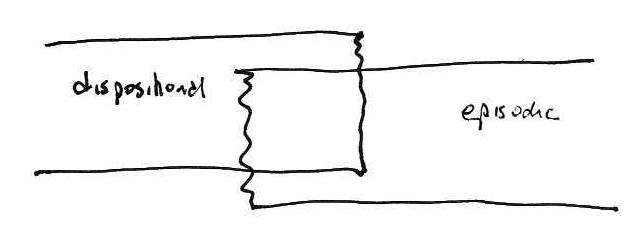
So I will diagram these categories like this:
The squiggly edges mean we won’t assume there is a sharp boundary there. Perhaps every mental state belongs wholly on one side or the other. But some philosophers think that certain states have both dispositional and episodic aspects. We won’t need to settle that dispute.
Next we’ll consider a different contrast by which mental states are classified.
Many mental states are representational or, as philosophers sometimes say, intentional. (We’ll talk about this use of the word “intentional” below.) They represent something: they may be about an object, person, place, or event, or represent things as being a certain way. Philosophers often describe this by saying that the state has content.
For example, a belief might be about Charlotte and represent Charlotte as being south of Carrboro. A false belief that Charlotte is north of Raleigh would still represent Charlotte and Raleigh, even though it represents their locations incorrectly.
This distinction will matter when we interpret Chiapa. We observe that Chiapa responds differently to Casey than to other people. This might mean that he’s learned some association involving Casey. A bolder hypothesis is that he’s representing Casey in a way that goes beyond “mere association.” And if we accept he is representing Casey, it’s a further question what Chiapa represents about Casey: that Casey is dangerous? Casey did something bad? Avoid Casey? Something else?
Some of these candidate contents can straightforwardly be expressed as propositions; perhaps others cannot. We won’t assume that every kind of mental representation has to have a complete proposition as its content.
An especially important kind of representational state is a propositional attitude. A proposition is something that can be true or false: for example, Charlotte is south of Carrboro. Different mental states can take different “attitudes” toward the same proposition: you might believe it, hope it is true, fear it is true, expect it to be true, and so on. A propositional attitude is a kind of mental stance toward, or way of being mentally related to, a proposition. (Outside the philosophy classroom, people use “attitude” for things like moods, emotions, acting snobby. But philosophers use the word in a broader sense to mean any kind of mental relation to a content.) When the state is a propositional attitude, the proposition believed, hoped, feared, etc. is what philosophers call its “content.”
Other examples of representational states / propositional attitudes: hoping that something is true, expecting it will be true, fearing that it will be true, being angry or happy or disappointed or relieved that it’s true.
Knowing that something is the case and remembering that it is the case are also often grouped with propositional attitudes. They differ from beliefs, hopes, fears, and many other attitudes in an important respect: you can only know or remember that something happened if it really did happen. That is, these are attitudes you can only have towards true propositions or facts.
In this course we’ll often be talking about propositional attitudes, though sometimes philosophers also discuss other possible kinds of mental representation.
Another important feature of some mental states is that there is something it is like for the subject to be in them. Pains, tickles, tastes, color experiences, feelings of warmth or cold, and many emotions have this feature.
Philosophers describe such states as qualitative or phenomenal, and call the distinctive way they feel their qualitative or phenomenal character. The term qualia is also sometimes used for these features.
Different pains can have very different phenomenal characters — a dull ache, a sharp stab, a burning pain — but in each case there is some way the experience feels to the creature undergoing it.
This is different from representation. A belief that Casey is dangerous has a content: it represents Casey as being dangerous. A feeling of pain has a way it feels. We shouldn’t assume either that these features always go together or that they always come apart.
Fear may have both aspects: a state may represent Casey as threatening, while also having a distinctive phenomenal character — there is a particular way the fear feels.
Be careful with the word “feeling.” Sometimes it means specifically a conscious sensation or phenomenal experience; sometimes people use it more broadly for any emotion such as fear, anger, or excitement.
These classifications cross-cut each other. A pain you are feeling now can be episodic and qualitative. Your standing belief that it will rain can be dispositional and representational. You can have that belief even at times when you’re not actively thinking about rain. On the other hand, your presently thinking to yourself “It will rain” can be episodic and representational. Some states, such as fear or perceptual experience, may have both representational and qualitative features.
So these are partly independent contrasts, not four competing boxes into which every mental state has to be sorted.
We won’t need a complete theory of how these categories relate to each other. (Which is good, because philosophers disagree about it.)
The categories we looked at aren’t meant to provide an exhaustive taxonomy of everything that belongs to mental life. They’re labels you’ll see in some of our readings, and tools for separating some questions that will matter in these readings.
“Star Witness” raises many different questions about Chiapa’s mind. It will help not to bundle them all together as the question whether Chiapa is “intelligent” or “has a mind.”
States and capacities: Does Chiapa remember a particular event involving Casey? Does Chiapa have a more general capacity to remember past events at all? Can Chiapa recognize particular people, understand words, form beliefs, or communicate information?
Episodic and dispositional: Chiapa might have an episode of feeling frightened when Casey appears. Chiapa might also have a standing fear of Casey while presently feeling calm.
Representational: If Chiapa believes or remembers something about Casey, what exactly is the content of that state? Evidence that Chiapa associates Casey with something bad need not by itself tell us exactly what Chiapa represents about Casey.
Qualitative: Separate questions concern what Chiapa consciously experiences — for example, whether Chiapa feels fear or pain, and what those experiences are like for him.
These capacities and states may come apart. Evidence that Chiapa has one doesn’t automatically establish that he has all the others.
And notice that all of these are claims about Chiapa’s mentality — about what states and capacities Chiapa has. Chiapa’s words, movements, reactions, and other behavior are instead among the evidence we use when deciding which of those claims to accept.
In our opening classes and the Terms & Methods notes, I distinguished between:
For example, concerning Chiapa, we could ask:
Later we’ll ask broader metaphysical questions about minds, for example, whether mental states are wholly physical states or processes, or whether minds involve something nonphysical. These are related to our third kind of question, about what mentality consists in. They shouldn’t be confused with questions about how we detect mentality.
Philosophers use the label the problem of other minds for questions about how we can know about the mental lives of creatures other than ourselves.
There is an important asymmetry here. For at least some of your own mental states — especially current experiences such as pain — you don’t ordinarily infer that you have them by observing your own behavior. You seem to know about them more directly. With another person or animal, by contrast, we usually rely on what they say and do, the circumstances they’re in, their bodily responses, and other evidence.
As I said in class, when we ask how we can know something, we aren’t going to demand certainty. Ordinarily we think we have very good reason to believe other humans have minds, even though their mental states aren’t as accessible to us as our own are. We’ll be asking what kinds of evidence or reasons we have to attribute particular mental states and capacities to other creatures, and how strong that evidence is.
Our inquiry won’t pursue the general skeptical question whether we can know anything at all about minds other than our own. It will be more practical: What observable evidence makes particular interpretations of another creature’s mental life reasonable?
When we discuss these questions, sometimes we start with a hypothesis about a creature’s mental state, and ask what observable evidence we would expect if that hypothesis were true. Other times we start with some behavior or bodily response, and ask which hypotheses about the creature’s mental life that evidence supports.
Keep track of which side of these inferences you’re talking about. A belief, memory, fear, or intention is something we’re attributing to the creature. Its words, movements, physiological reactions, and other observable responses may be evidence for that attribution.
Don’t confuse what Chiapa believes, remembers, wants, etc. with the behavior that gives us evidence about what Chiapa believes, remembers, or wants.
The next several meetings will focus on how we should reason between those two sides: from observable behavior to hypotheses about mentality, and from hypotheses about mentality to predictions about what behavior we should expect.
A further complication is that the same behavior may fit several different hypotheses about what is going on mentally. How can further evidence help us choose among them?
In addition to the category labels introduced above (episodic, dispositional, propositional attitudes, representational, qualitative/phenomenal), you’ll likely encounter some other special vocabulary in our readings. Here is some of it.
I mentioned above that philosophers sometimes use the label intentional to mean the same as representational. This is a special technical use of the word “intentional.” There is also the more familiar use of that word from ordinary language, where it instead means something like “on purpose” or “planned.” (Did you spill that beer intentionally, or was it an accident?) Philosophers sometimes use the word with that meaning too, especially in discussions of action and responsibility.
We’ll see an example of that more familiar meaning in our next reading, from Dr Dolittle’s Delusion, when discussing whether the broken-wing behavior of plovers is intentional.
But you should realize that some philosophers, when they say “intentional,” mean the broader idea of any representational state. This can include people’s intentions/plans, but it will include their beliefs and fears and regrets as well.
Note how we spelled the term “intentional.” There’s another term you may encounter in your reading, that’s spelled like this: intensional (with an “s” where the other word has a “t”). These concepts are connected but different. We’ll talk about the term “intensional” again in later classes.
Another special word is cognitive. This word is used somewhat differently by different writers. In discussions of animal cognition, it can have a broad use covering perception, learning, memory, representation, problem-solving, reasoning, and related psychological capacities. But some philosophers use it more narrowly, especially when contrasting cognitive states such as beliefs or judgments with desires, emotions, feelings, or other parts of mentality. For instance, a “cognitive theory of fear” would be a theory that says fearing trolls always requires (and on some versions, may wholly consist in) having some belief, such as the belief that trolls are dangerous or may hurt you.
So don’t assume that every author who uses “cognition” is drawing exactly the same boundary.